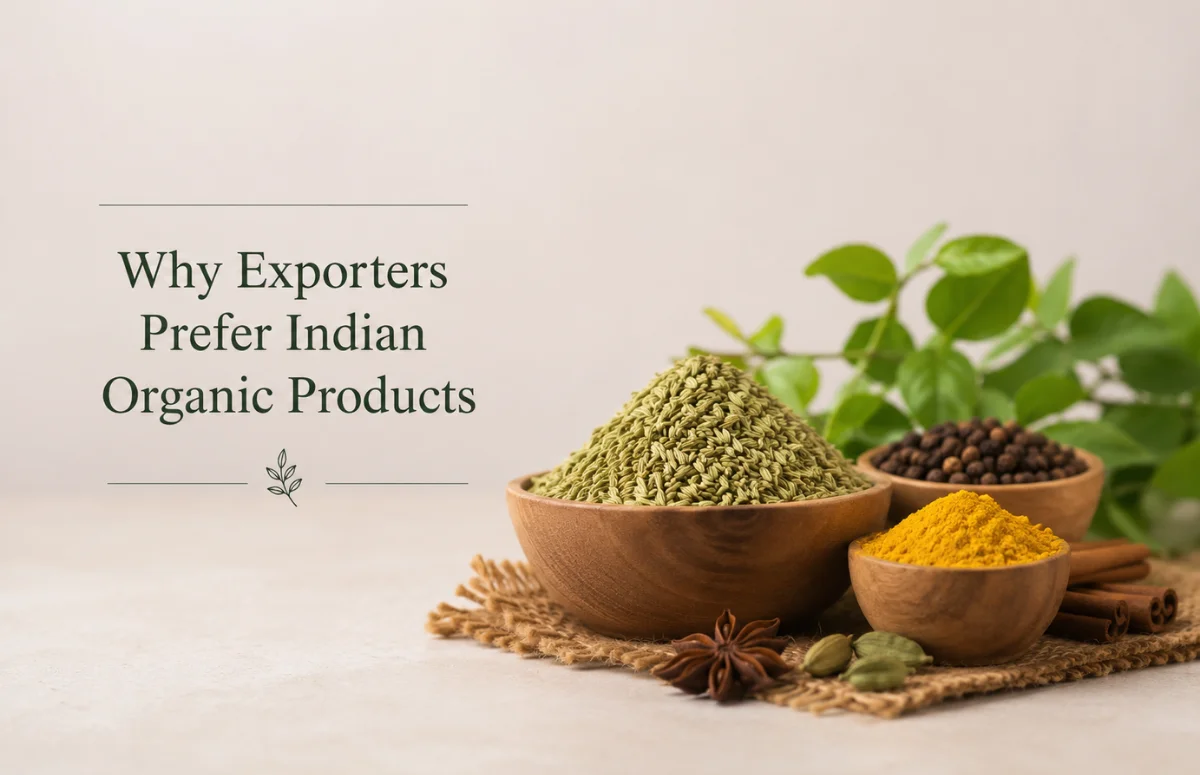
A few months back I was chatting with a friend. Who runs a small import business out of Rotterdam and he said something that stuck with me. He said Every time I want organic turmeric or basmati that actually tastes like something. I end up back in India. Not Sri Lanka not Vietnam not even the usual Eastern European suppliers he uses for grains. India. And honestly once you spend enough time around this industry you start noticing the same pattern. Everywhere buyers from Germany the US the UAE Japan. They all seem to circle back to Indian suppliers for organic goods. Even when the paperwork and logistics are let’s be real not always the smoothest.
So what’s actually going on here? Why does a country with such a chaotic reputation for infrastructure end up. Being one of the most trusted sources for organic exports in the world?
It’s not just about organic it’s about scale and diversity
Here’s the thing people outside the industry often miss. India isn’t just growing one or two organic crops well. It’s producing an enormous range rice pulses, spices, tea cotton oilseeds even organic sugar across dozens of agro climatic zones. You have got the black soil belt in Madhya Pradesh growing organic soybean. And wheat, the hill regions of Uttarakhand and Sikkim. (which by the way was declared a fully organic state back in 2016). And then down south you have got organic spices coming out of Kerala and Karnataka. That kind of geographic spread means an exporter can source ten different commodities. From one country instead of juggling relationships across five.
I’ll admit, when I first got into sourcing conversations, I assumed this diversity would make quality control a nightmare. Turns out it’s actually the opposite in many cases. Because different regions specialize farmers tend to know their crop inside and out. A cotton farmer in Gujarat is not trying to also grow rice he’s spent generations perfecting one thing.
The certification ecosystem actually works (mostly)
Now, this is important, and it’s something a lot of casual observers get wrong. India has NPOP the National Programme for Organic Production. Which is recognized as equivalent by the EU and a few other major markets. That equivalence matters enormously for exporters because it cuts down on double certification costs. You are not paying for an Indian cert and then a separate EU cert from scratch there’s a recognized pathway.
Is the system perfect? No not even close. There have been scandals there have been fraudulent certificates floating around and buyers. Who have been burned once tend to get very cautious very fast. But the system has matured a lot in the last decade. Traceability requirements have tightened, and third-party audits are far more common now than they were even five years ago. Serious suppliers the ones actually worth working with invest heavily in this. Because they know one bad shipment can wreck years of trust.
Cost obviously but not in the way people assume
Everyone assumes India wins on price alone and sure, labor costs are lower than in Western Europe or North America. But that’s a lazy explanation and it does not hold up when you look closer. Organic farming is labor intensive everywhere you can not just spray. Your way out of a pest problem you need manual weeding composting crop rotation planning. What India offers is ornot cheap labor exactly. It’s abundant skilled agricultural labor that’s been doing this kind of farming, in some form, for generations. Traditional Indian farming was largely organic by default before the Green Revolution pushed everyone toward chemical inputs. So in a weird way a lot of Indian organic farming is not a new trend being adopted. It’s a return to older practices that never fully disappeared especially in tribal belts and remote hill areas. Where chemical fertilizers never really penetrated the supply chain.
Six kinds of suppliers exporters actually deal with
If you talk to enough procurement managers. You start to notice they are not really dealing with Indian organic. Suppliers as one blob there are distinct types and each comes with its own pros and cons.
There are the large integrated exporters usually based out of Mumbai Ahmedabad or Delhi-NCR. Who handle everything from farm tie-ups to processing to container loading. These are the ones big retail chains abroad prefer because there’s one point of accountability.
Then you’ve got farmer producer organizations, or FPOs. Which have grown massively over the last ten years thanks to government push. These are cooperatives where a few hundred (sometimes a few thousand) small farmers pool their produce. Buyers who care about ethical sourcing narratives and there are a lot of them. Now especially in Europe love working with FPOs. Because the story writes itself: direct farmer benefit transparent pricing all that.
Regional specialists are another category worth mentioning outfits. That only do one or two products like a Rajasthan-based cumin and fennel exporter. Or a Kerala pepper house that’s been in the same family for three generations. Less flexible in terms of product range, but the quality knowledge runs deep.
There are also processing led suppliers companies that do not grow much themselves. But specialize in cleaning grading and packing organic produce to export spec this matters more than people think. Because raw organic produce straight off the farm rarely meets the moisture content purity percentage or packaging standards. That a European or Japanese buyer needs.
Newer digital first platforms have also entered the space connecting farmers directly to overseas. Buyers through online catalogs and sample requests cutting out a layer or two of middlemen. I have come across a few of these while researching sourcing options. And sites like indianfarmorganics.com are a decent example of how this model is trying to make the discovery. Process less painful for smaller international. Buyers who do not have a procurement team on the ground in India.
And finally there are the government-backed or APEDA-affiliated trading houses. Which tend to be slower moving. But come with an extra layer of institutional credibility that some risk-averse buyers specifically want.
How exporters actually pick a supplier the unglamorous truth
Nobody picks a supplier purely off a nice website or a glossy catalog, though it helps. What actually happens from what I have seen, is a fairly unromantic process. Buyers ask for samples first always. Then they check certification validity directly with the certifying body rather than trusting a scanned PDF. Because forged certificates aren’t unheard of. They ask about minimum order quantities because a supplier. Who can not handle a smaller first order is often not worth the relationship. Building effort for a new buyer testing the waters. Payment terms matter more than people admit a supplier insisting on 100% advance for a first-time buyer raises flags. Whereas one open to LC or partial advance signals confidence.
Honestly speaking, the single biggest differentiator isn’t price or even certification it’s communication. A supplier who responds within a day sends clear documentation without being chased three times and is upfront about delays. (because delays happen especially with seasonal crops) tends to win repeat business. Over one who’s cheaper but goes silent for a week at a time. If you are evaluating an organic food supplier in India for the first time. That responsiveness during the negotiation stage tells. You almost everything about how the actual shipment process will go.