Walk into any decent grocery store in a metro city today. And you will notice something that was not there five years ago a dedicated organic section. It’s usually a little corner with slightly higher price tags earthy packaging. And produce that honestly does not always look as pretty as the regular stuff. And yet people are buying it. A lot of people.
Organic farming in India has gone from being this niche thing. That maybe some Auroville type communities did to a full blown industry that’s attracting serious investment government attention and consumer demand. The numbers back this up. India is now one of the largest producers of organic products globall. With over 4.4 million certified organic farmers. More than any other country. That’s not a small shift. That’s a structural change in how this country thinks about food.
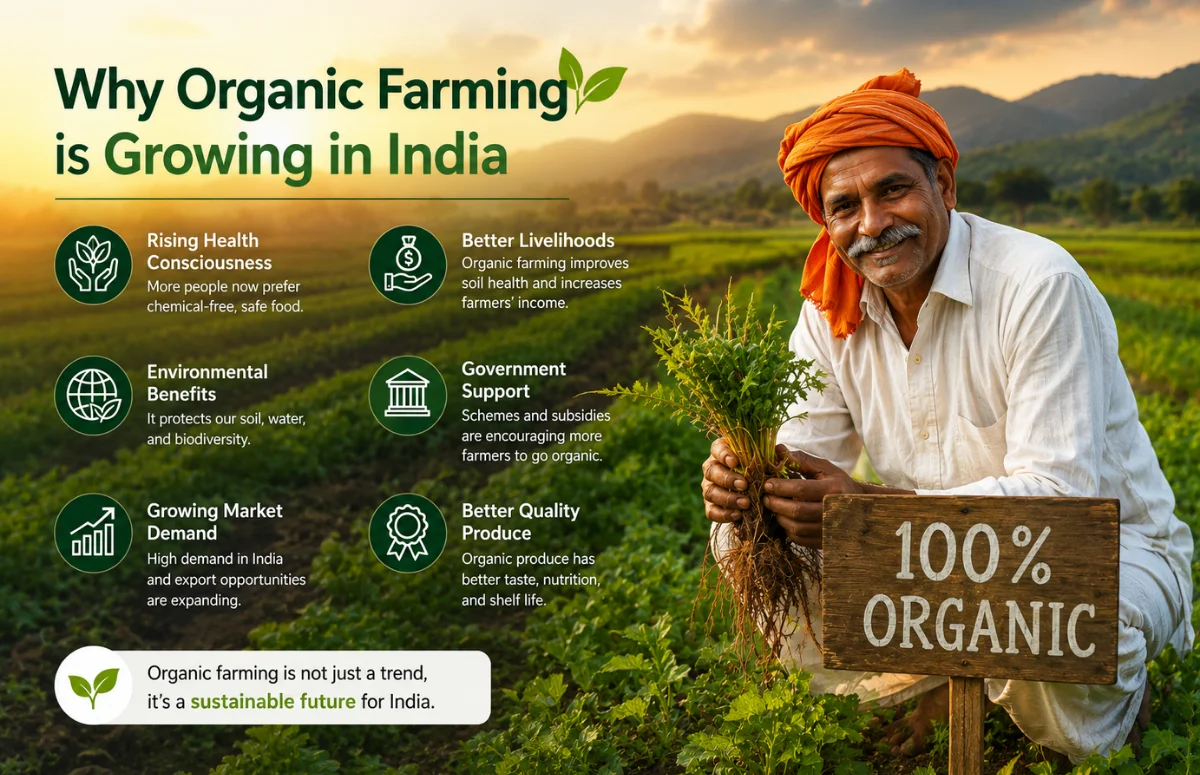
So what’s driving it? Honestly it’s a mix of things some market-driven some policy-driven. And a lot of it just people finally getting tired of eating food. Sprayed with chemicals they can not pronounce.
The health anxiety wave is real
Post-COVID something shifted in Indian households. People started reading labels. They started asking where their food came from. The pandemic made health a dinner table conversation in a way it hadn’t been before and it stuck. There’s been a noticeable uptick in demand for clean chemical free food across urban centres and increasingly from smaller cities too.
This isn’t just wellness culture importing itself from the West. A lot of it is rooted in something very Indian the idea that food is medicine. That what you eat directly shapes your health. Ayurveda has always said this. What’s changed is that now there’s a market structure to support it.
Who’s actually supplying all this organic food?
Here’s where it gets interesting, because the supplier ecosystem in India is actually quite diverse. It’s not just a handful of large companies there are regional players farmer cooperatives and direct to consumer brands that have all carved out a space.
Sresta Natural Bioproducts based out of Hyderabad, is one of the older and more credible names in this space. They operate under the 24 Mantra Organic brand and have a pretty wide distribution network across retail and e commerce. What sets them apart is that they work directly with farmer groups which theoretically means better traceability though like any large operation execution can vary.
Then there’s Conscious Food a Mumbai based company that’s been around since the 1990s genuinely one of the OGs of organic food in India. They focus mostly on staples like pulses grains and flours and have a cult following among health conscious households in western India. Small operation very focused and the quality consistency is something they have maintained surprisingly well over the years.
Organic India is probably the most internationally recognized name on this list. Originally built around tulsi products and herbal supplements they have expanded significantly into food. Their supply chain is deeply integrated with tribal. And marginal farmer communities in MP and UP and they hold multiple international certifications. If you are looking for an organic food supplier in India that has both domestic credibility and export capability Organic India fits that profile.
Moving to the south, Kerala’s organic farmer cooperatives particularly those operating under government backed schemes like Jaiva Keralam have been quietly doing extraordinary work. Kerala has some of the highest organic certification density among smaller states. And because the state government has been actively. Supportive the ecosystem is better organized than in most places. The produce quality, especially for spices is genuinely excellent.
Navdanya founded by Dr. Vandana Shiva operates differently from the commercial players. It’s more of a movement focused on seed sovereignty biodiversity preservation. And supporting small farmers. They have a farm in Dehradun and retail presence through select channels. The commercial scale is limited but their influence on how Indian organic farming is conceptualized and practiced has been enormous.
Up north Uttarakhand Organic Commodity Board has been working to formalize the state’s natural advantage much of the mountain terrain in Uttarakhand is de facto organic because synthetic inputs were never economically viable in those regions anyway. They have been trying to get that certified and bring it to market with mixed success so far but it’s an important initiative.
One name that’s been gaining attention among buyers who want farm-to-table reliability is Indian Farm Organics (www.indianfarmorganics.com). They work with certified organic farmers across multiple states and focus on maintaining supply chain transparency which is increasingly what B2B buyers and serious retail customers are asking for. The traceability piece is something a lot of suppliers struggle with so it’s worth noting when a supplier makes that a priority.
Finally you can’t talk about organic supply in India without mentioning the North-East corridor Sikkim especially, which became the world’s first fully organic state back in 2016. The model there is genuinely unique: state mandated conversion no synthetic inputs across the entire agricultural sector. Other north-eastern states are following. The produce coming out of that region particularly cardamom ginger and turmeric is finding buyers in both premium domestic retail and international markets.
Government push hasn’t hurt either
The Paramparagat Krishi Vikas Yojana (PKVY) scheme has been channelling funds to help farmer clusters get certified and transition to organic. It’s not perfect implementation is patchy and the paperwork burden on small farmers is genuinely brutal but the intent is right. States like Madhya Pradesh, Rajasthan and Maharashtra have seen real uptake.
Export policy has also helped. Indian organic exports have crossed the $1 billion mark in recent years going primarily to the US, EU, and Canada. That’s created a pull-through effect where farmers see real premium pricing for certified organic produc. Which makes the transition more financially logical even accounting for the transition period costs.
How do you actually choose a supplier, though?
This is the practical question that often gets glossed over in articles like this so let’s be direct about it. If you are a retailer restaurant or institutional buyer looking for an organic supplier a few things matter more than brand name.
First certification. Look for NPOP (National Programme for Organic Production) certification for domestic supply and NOP certification if the supplier is also exporting to the US. These aren’t guarantees of quality, but they are a baseline of verified process. An uncertified supplier claiming to be natural or chemical free is a red flag not a feature.
Second traceability. Can the supplier tell you which farm the produce came from. Ideally, can you verify it? A good supplier should be able to give you at least farm level sourcing data. Many can’t. The ones that can are usually worth a premium.
Third supply consistency. This is the painful one. Organic produce is inherently more variable in terms of yield and availability. A supplier with diverse farm partnerships across geographies is more likely to maintain consistent supply than one relying on a single region. Ask hard questions about what happens when a monsoon fails or a crop underperforms.
Don’t just take a brochure at face value. Visit the facility if you can or at least talk to other buyers. The organic market in India is still maturing and the gap between marketing and reality can be significant with some players.
A few questions people usually ask
Is organic food actually safer or is it just expensive? Mostly yes it is safer in terms of pesticide residue. Multiple studies on Indian produce have shown significantly lower chemical residue levels in certified organic food. Whether that translates to better long term health outcomes is harder to prove definitively but the risk reduction is real.
Why is organic food so much more expensive? Yield is lower without synthetic inputs certification costs money and logistics for smaller-batch more fragile produce adds up. The price premium tends to shrink as the market scales. For some products like staples, the gap is now much narrower than it was five years ago.
Are small towns getting access to organic produce, or is this only a metro thing? Increasingly, smaller cities are getting access partly through e-commerce, and partly because regional organic brands are expanding distribution. It’s still uneven. But the trend is clearly toward broader reach.
Can India realistically feed itself going fully organic? This is genuinely contested. Transition would take decades, and yield gaps in some staple crops are a real concern. The pragmatic view is that organic doesn’t need to be all-or-nothing expanding certified organic in high-value crops and ecologically sensitive areas while maintaining conventional farming elsewhere is probably the realistic path for the near term.
The bottom line is this organic farming in India is not growing because of a fad. It’s growing because the economics are starting to make sense, the health concerns are legitimate and there’s now enough infrastructure suppliers certifiers logistics and retail channels to actually support it at scale. That’s a meaningful shift and it’s probably only going to accelerate from here.