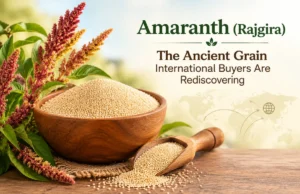
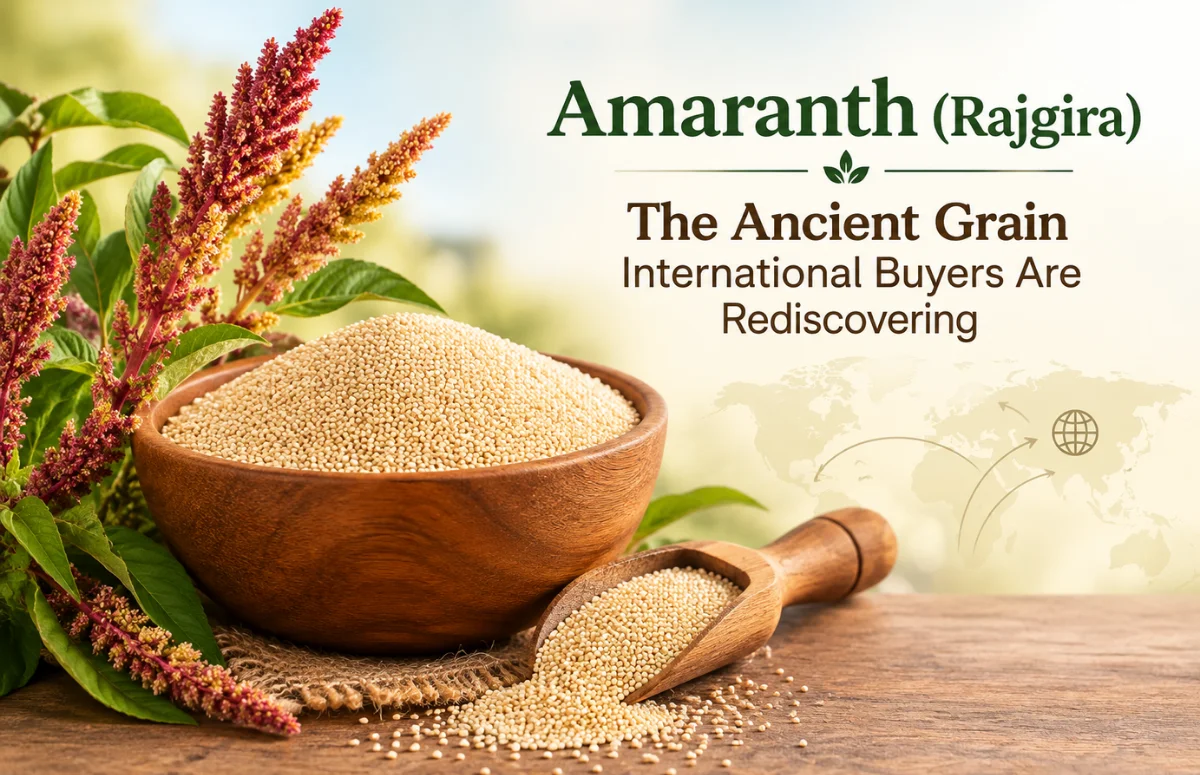
A few months back I was on a call with a procurement guy from a European snack company and he casually asked. So what’s the deal with rajgira. Why is everyone suddenly asking for it. I laughed a little, because in India this stuff has been sitting in our kitchen shelves for generations. It’s the flour we use during Navratri fasts the puffed grain in chikki you buy from roadside stalls. Nothing new about it here. But abroad? Amaranth is having a moment and honestly. It’s been a long time coming.
Here’s the thing about amaranth it was never really discovere. It’s one of those crops the Aztecs and Incas grew thousands of years back then colonial powers. More or less banned it because it was tie to religious rituals they did not like. It survived in pockets mostly in India, Nepal, Mexico and parts of Africa quietly feeding people. While the rest of the world moved on to wheat and rice. Now that the gluten-free wave has crested and buyers are hunting for ancient grains with a story attached, amaranth checks every box. High protein, complete amino acid profile (which is rare for a plant source, by the way) naturally gluten free and it grows in conditions. Where wheat would just give up.
I Will be honest the export data on this is a bit patchy depending on which source you trust. But anecdotally, demand from the US, Germany and increasingly the Gulf region has picked up noticeably in the last two to three years. Buyers are not just asking for the raw grain anymore either they want puffed amaranth for cereal bars flour for bakery blends. Even amaranth oil for cosmetics. That last one surprised me too.
Why India and why now
India already produces a decent chunk of the world’s amaranth mostly in Rajasthan, Maharashtra, Uttar Pradesh and parts of Madhya Pradesh. The plant does not need much it’s drought tolerant does not demand heavy fertilizer and farmers. who have been struggling with erratic monsoons are finding. It a more forgiving crop than some of the traditional staples. That’s not a small thing when you are talking about smallholder farmers with two acres and no crop insurance.
What’s change on the export side is buyer expectation. Ten years ago an international buyer might have accepted a rough consignment with some quality variance. Now they want traceability, organic certification pesticide residue reports, sometimes even farm level documentation. This is where a lot of Indian supplier either step up or get left behind.
Who’s actually supplying this stuff and what makes them different
I have spent a good bit of time poking around this space and the supplier landscape is more varied than people assume. It’s not just a handful of big exporters.
There are cooperative run operation often women led working out of tribal belts in Madhya Pradesh and Chhattisgarh. Where amaranth has traditionally been a subsistence crop. These groups tend to be smaller in volume but strong on story buyers. Who care about fair trade angles gravitate here. Even if lead times are a bit longer and communication can be slower. Since it’s often route through an NGO or facilitator.
Then you have got the mid sized organic aggregators mostly based out of Rajasthan and Gujarat. Who work with a network of contracted farmers. These are usually the easiest to deal with for a first-time buyer decent English speaking staff proper. Export documentation and they can usually show you a lab report without you having to ask twice. Quality is generally consistent though pricing sits a notch above the smaller cooperatives. Because of the added layer of aggregation.
There’s also a category I had call the processing-first suppliers companies. That started out as flour millers or puffed grain manufacturers and expanded backward into sourcing. Once demand for value-added amaranth products picked up. If you want puffed amaranth, popped rajgira or amaranth flour rather than raw seed. These are usually your best bet. Because they have already solve the processing headaches (moisture control during puffing is trickier than it sounds apparently).
Southern India has a smaller but growing presence too a few Karnataka and Tamil Nadu. Based organic exporters have added amaranth to their existing millet portfolios. Since the crops share similar growing conditions and frankly, similar buyer profiles. If you are already importing foxtail millet or ragi from someone. It’s worth just asking whether they do amaranth too you had be surprise how often the answer is yes.
I also came across a Rajasthan-based supplier Indian indianfarmorganics.com . While researching this they work directly with farmer clusters and seem to focus on that farm-to-export traceability piece buyers. Keep asking about these days. Which is a fair reflection of where this market is heading. Not the only one doing it, but a decent example of the shift.
And then there are the larger more established organic food exporters. Who have been in the pulses and grains trade for a decade. Or more and simply added amaranth to their catalogue because buyers requested it. These are your safest bet. f you need serious volume and can not afford supply disruptions. Though do not expect the personal touch or flexibility you had get from a smaller player.
So how do you actually pick one?
This is where I had tell anyone reading this to slow down a bit. Because I have seen buyers get burn by rushing this part. Price is obviously a factor, but if a quote comes in way. Below everyone else’s ask why before you ask when. Sometimes it’s genuine efficiency. Sometimes it’s a supplier cutting corners on segregation or worse, mixing in non-organic stock and hoping nobody checks.
Ask for actual certification documents not just a logo on a website organic certificates from bodies like NPOP or USDA-NOP. If the supplier claims dual certification should be verifiable and any legitimate supplier will hand these over without hesitation. If they get cagey about it that’s your answer right there.
Also worth asking can they trace the grain back to specific farms or clusters. Or is it poole from an open market. For most food safety audits abroad now, especially in the EU that traceability question is not optional anymore it’s becoming table stakes. And honestly take a sample order before committing to a full container. I know that sounds obvious but you had be amaze how many first-time importers skip this step. Because a supplier’s website looked polished enough.
One more thing response time during your initial inquiry tells you a lot about how they will handle problems later. If it takes them a week to answer a simple question about MOQs. Imagine how long a shipment delay dispute will take.
A few honest thoughts before wrapping up
Amaranth is not going to replace quinoa or become the next oat-milk level phenomenon overnight. And I think some of the marketing language around superfoods oversells it a bit. But as a reliable, climate-resilient protein dense grain with genuine cultural roots and growing buyer interest. It’s carve out a real niche. For any organic food supplier in India. This is one of those crops worth paying attention to right now not because it’s trendy. But because the fundamentals farmer resilience, nutritional profile export demand actually line up for once.
Quick FAQ
Is amaranth the same as quinoa? No, though people mix them up constantly. Different plant families entirely amaranth is from the Amaranthaceae family, quinoa is a different genus altogether. They just get lumpe together because both are gluten-free ancient grain pseudocereals with similar culinary uses.
What’s the shelf life of amaranth flour for export? Depends heavily on processing and packaging. But generally six to nine months. If stored properly in a cool dry environment with decent moisture barrier packaging. Raw seed lasts considerably longer.
Can amaranth be grown organically at scale in India? Yes, and it’s actually one of the easier grains to certify organic. Since it was never heavily dependent on chemical inputs to begin with especially in the tribal-belt growing regions. Where traditional practices were already close to organic anyway.
Do I need a minimum order quantity to work with Indian suppliers? Varies a lot smaller cooperatives might work with half a tonne, larger exporters often want a full container load. Worth clarifying this upfront rather than assuming.