Let me be honest the first time. I tried sourcing organic produce for a small health food brand I was consulting for I assumed the word “organic” on a supplier’s letterhead was enough. It wasn’t We got two batches that didn’t pass third-party residue testing, and explaining that to the brand owner was not a fun afternoon.
Verifying organic certification sounds like it should be simple. You ask for a certificate, they send one, done. But the reality of working with suppliers especially in a market as large and fragmented as India is messier than that. Certificates get misrepresented. Scope gets stretched. And plenty of suppliers who technically hold some form of certification are selling you product outside that certification’s scope without you even realizing it.
So here’s what actually works.
Start With the Certificate But Don’t Stop There
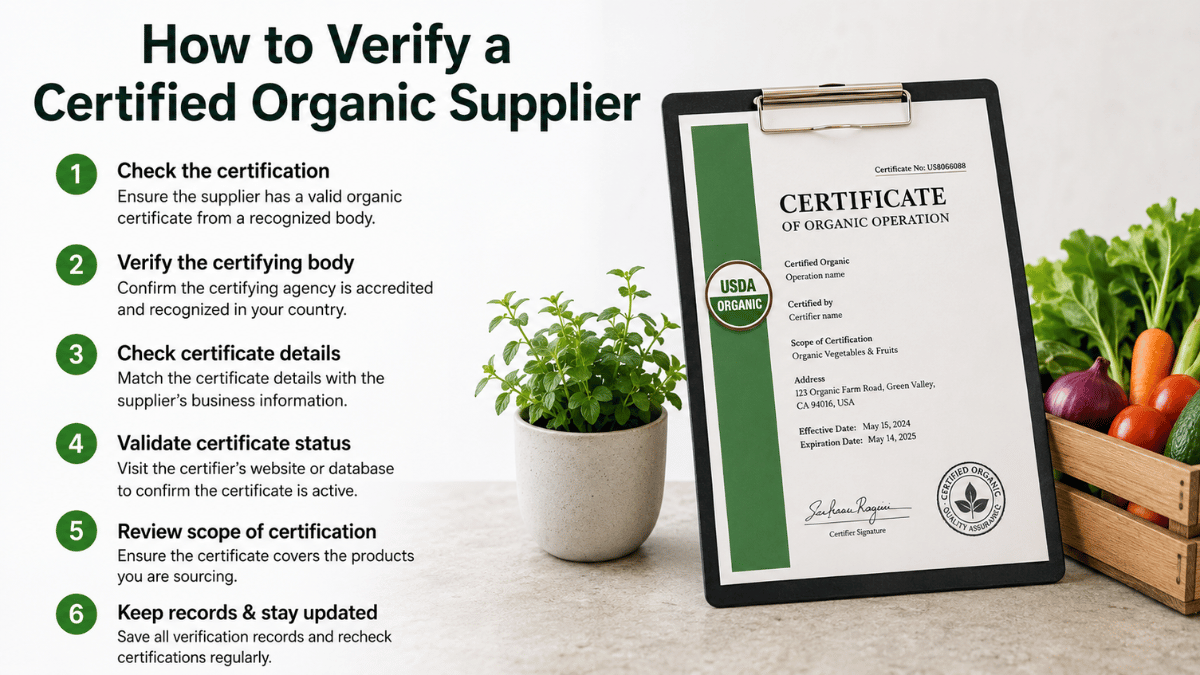
The first thing any serious buyer should ask for is the organic certificate. Not a scan of it. Not a screenshot from a brochure. The actual certificate, with the certifying body’s name the certificate number the scope of certification. Which crops or products are covered and the validity period.
Here’s the thing a certificate is only as good as the body that issued it. In India the regulatory framework for organic certification runs under APEDA’s National Programme for Organic Production (NPOP). If you are buying for export to the EU or US, NPOP certified suppliers generally meet the equivalency requirements. For domestic trade PGS-India (Participatory Guarantee System) is a government. Backed alternative particularly common among small and marginal farmers.
The moment you get a certificate cross reference the certificate number directly with the certifying body. Most of the major accredited certification agencies in India like OneCert Asia, ECOCERT India, Control Union Lacon Quality Certification or IMO maintain online databases or will verify a certificate by email. Don’t skip this step. It takes ten minutes and has caught more than a few fraudulent claims over the years.
Know Who the Major Players Are (And How They Differ)
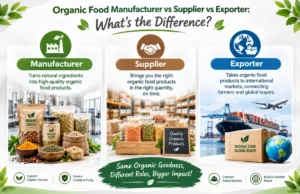
India’s organic supply ecosystem is genuinely diverse. You have got large export oriented operations farmer producer. Organizations processing units and small batch specialty suppliers all operating under the same broad “organic” label. They are not the same and understanding the landscape helps you ask the right questions.
Organic India is probably one of the most recognized names globally. They work with a large network of tribal and small farmers mainly in Madhya Pradesh and Uttarakhand and have maintained USDA NOP and EU organic certification for years. Their supply chain is reasonably transparent if you ask for it.
24 Mantra Organic has built a solid reputation as a large scale certified organic food supplier, sourcing across multiple states and supplying both retail and B2B. Their certification scope is broad grains pulses spices, oils which makes them a common starting point for brands looking for variety without juggling multiple vendor relationships.
Sresta Natural Bioproducts the company behind 24 Mantra also runs farmer connect programs that let buyers trace product origin more granularly. That kind of traceability infrastructure matters.
Nature Bio Foods out of Haryana is another major exporter. They work primarily with European and North American markets and hold both NPOP and NOP certifications. Worth looking at if you are sourcing for export they tend to have documentation that’s already formatted to international standards.
Indian Farmers Fertiliser Cooperative (IFFCO) has been building organic verticals though their primary scale remains conventional. Worth watching but verify scope carefully.
On the smaller more specialized end companies like Dhatu Organics (based in Bangalore) and Down to Earth Organics serve niche segments with higher traceability and farm level data. They are often harder to scale with but offer product integrity that larger operations sometimes can’t match.
One supplier that’s come up in sourcing conversations more recently is Indian Farm Organics. Which positions itself as a farm-to-buyer organic food supplier in India with direct farmer partnerships. The appeal there is the shorter chain fewer intermediaries generally means fewer points. Where something can go wrong or get misrepresented.
Scope Creep Is Real Watch for It
One thing that doesn’t get talked about enough: certification scope. A supplier might be genuinely certified for say organic basmati rice and sesame. But if you ask them for organic black pepper and they say yes without hesitation, that’s a flag. Either they have expanded their sourcing without updating their certification or they are sourcing from a third party and passing it off under their own cert.
Always ask “Is this specific product within your certification scope?” And then check the certificate’s product annex yourself. This sounds tedious. It is. But it’s also exactly the kind of thing that gets brands in trouble during retailer or regulatory audits.
Audit Rights and Farm Visits More Useful Than They Sound
If you are sourcing at any meaningful volume, building an audit clause into your supplier agreement is not paranoia it’s standard practice. The right to visit farms or processing facilities, even if you rarely exercise it changes the dynamic of the relationship. Suppliers who resist this aren’t automatically dishonest but it’s worth probing why.
Farm visits even informal ones reveal a lot. Look at the buffer zones between organic and conventional fields. Ask to see internal inspection records. Talk to the person who actually manages the certification not just the sales contact. Honest operations generally welcome this. They have invested a lot in their certification and they want you to understand that.
How to Actually Choose Between Suppliers
Honestly speaking, the certification check is table stakes. Once you have verified that a supplier is legitimately certified and that the product. You want is within scope the next layer is operational fit.
Ask about their capacity and lead times during peak seasons. Ask whether they batch test for residues beyond. What certification requires (some do, voluntarily). Ask about their rejection and recall processes
not because you expect problems, but because how they answer tells you a lot about their systems.
Pricing is obviously a factor, but a supplier quoting significantly below market for certified organic product is a red flag not a bargain. Organic certification costs money. Maintaining it costs money. If the math doesn’t add up something else is happening.
Payment terms packaging standards labeling compliance these matter too especially if you are selling into modern retail or e-commerce where label claims get scrutinized. An organic food supplier in India that has export experience will generally have tighter documentation habits than one operating purely in domestic wholesale. Not always, but often.
A Few Questions I Get Asked a Lot
Q: Is PGS-India certification as credible as NPOP?
For domestic markets, yes it’s government-recognized and audited through a peer verification system. For export most international buyers require NPOP or its equivalents so it depends on your end market.
Q: How often should I re-verify a supplier’s certificate?
Annually at minimum, or whenever a certificate is due for renewal. Certification lapses happen and suppliers don’t always proactively tell buyers when that happens.
Q: What if a supplier refuses to share farm-level details?
That’s a legitimate business conversation not an automatic disqualifier. But if they can’t give you any farm or region information, that’s harder to work with from a traceability standpoint. Depends on how much traceability your end customer or retail partner requires.
Q: Can I rely on third-party testing instead of certification?
You can use it as a supplement and honestly for certain products it’s worth doing regardless. But residue testing alone doesn’t verify organic practices it only catches certain inputs. Certification and testing work best together not as substitutes for each other.
The whole process of verifying a certified organic supplier is frankly more work than most sourcing teams expect upfront. But once you have done it properly with a handful of suppliers and built out a verification workflow it becomes manageable. The buyers who get burned are usually the ones who assumed someone else had already done the due diligence.