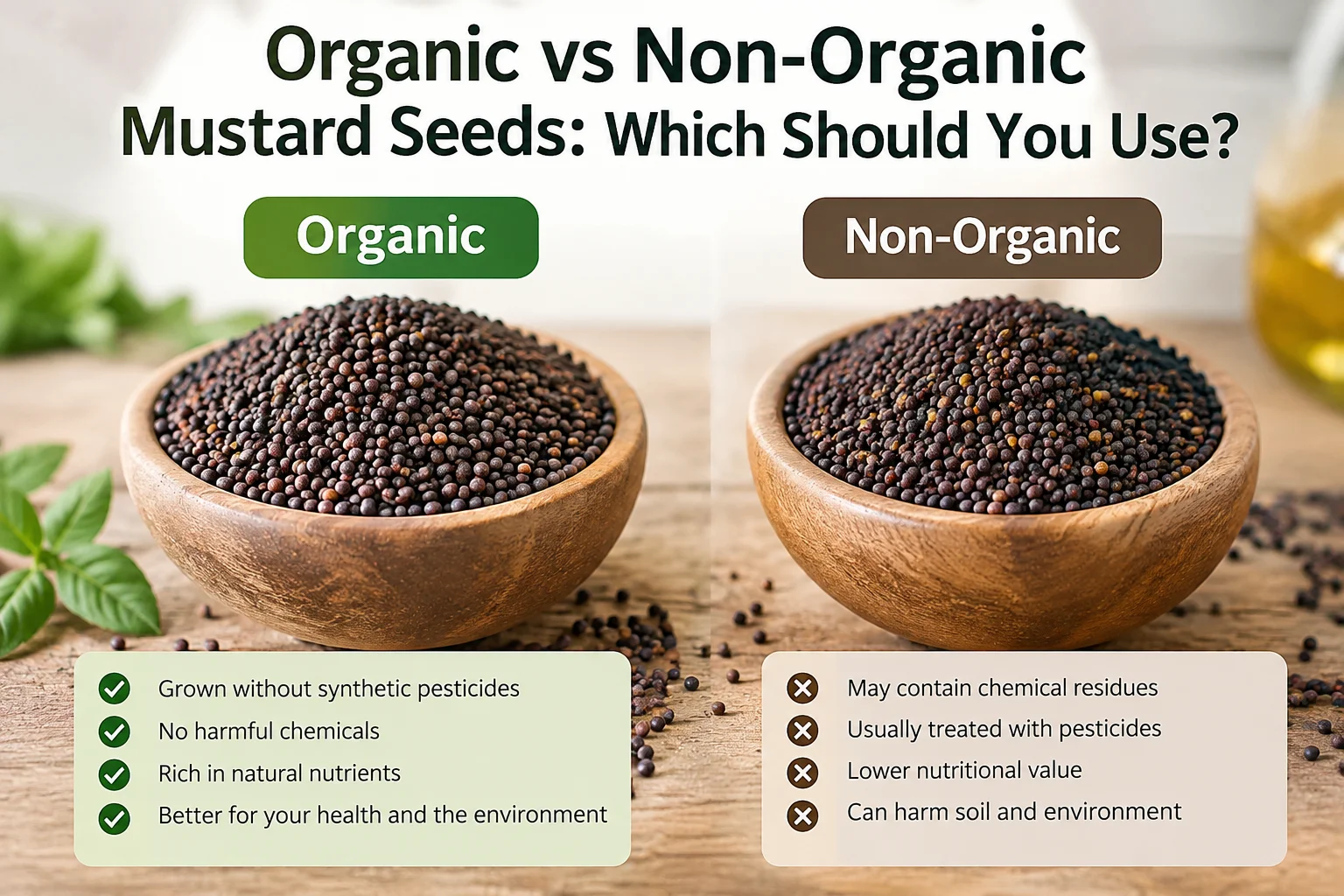
A few years ago I watched a friend who runs a small pickle business stand in a Neemuch mandi holding two handfuls of mustard seed. One was dark uniform and slightly dusty. The other looked nearly identical. The price gap was around 30 rupees a kilo. Is the extra money even real?. He asked me. Honestly I did not have a clean answer then. I have a better one now though it’s still not a one liner.
What “organic” actually changes
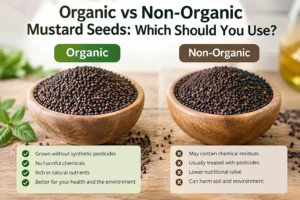
Mustard is a hardy crop. It grows through the Rajasthan winter without much fuss. Which is part of why conventional farmers lean on it. So the first thing to say is that non-organic mustard is not some toxic villain. Most of it is perfectly fine for tempering pickling and pressing into oil.
But organic means something specific. The seed was grown without synthetic pesticides or chemical fertilisers and here’s the part people skip someone certified that. In India that usually means NPOP and for export buyers USDA or EU organic as well. Without the paperwork organic on a bag is just a word.
Does it taste different? Sometimes slightly. Organically grown seed often has a sharper cleaner bite when you crush it. Though I wouldn’t promise that in a blind test. Where I had actually notice a difference is in cold-pressed oil. Because whatever is on the seed ends up concentrated in what you extract.
When non-organic is the sensible pick
Let’s be fair about this. If you are a restaurant buying 200 kg a month for tadka and cost is everything conventional seed from a good mandi trader is a reasonable call. Same if you are pressing oil for industrial use or you just need something to sprinkle into a sabzi.
The mistake is assuming cheap and conventional means bad. Quality has more to do with cleaning, moisture and how the lot was stored than with the farming method. A well-graded conventional lot beats a sloppy organic one any day.
When organic is worth the money
If you are making a product you sell under a natural or clean label banner. You are in a different game. Your customers may ask for documents. An exporter shipping to Europe or the US simply can not skip certification. And if you are a parent or home cook who uses mustard oil daily a few extra rupees per kilo is a small price for knowing what’s on the seed.
Here’s the thing though. Organic only helps if it’s real and that’s where supplier choice matters more than the label.
The suppliers worth looking at
I’ll be upfront. A lot of this market lives on B2B listings and what a listing says and what shows up at your door are not always the same thing. So treat what follows as a starting list not a guarantee. Ask for certificates and samples from all of them.
Start with Neemuch in Madhya Pradesh. It’s one of the big mustard and spice trading hubs and two names come up often. Gaurav Traders has been around since 1980 by its own account. And lists organic quality mustard seed meant for oil extraction. Pipada and Company listed since 2010 deals more in black mustard in bulk. Though its listing describes the cultivation as common so it reads more as a conventional supplier. Both are the sort of trader you had deal with by phone and by visiting.
Then there’s Unjha in Gujarat famous for its APMC spice market. VS Spices operating since 1996 lists black mustard under both organic and regular tags. I had want to see exactly which lot is certified before assuming everything they sell is.
In Ahmedabad Bharat Ohari Agro Traders LLP sources mustard from Rajasthan and Madhya Pradesh. Cleans and grades it and says organic and non-GMO options are available on request. On request is worth noticing. It usually means organic is not their main line so ask early about lead times and paperwork.
Jodhpur-based Lakshita Organics is interesting. Because it sells yellow mustard in conventional IPM and organic versions. That suits a buyer who is not sure yet which direction to go. You can compare the three grades from the same source.
Vedant Agro Foods in Pune lists organic yellow and white mustard and mentions use in condiment manufacturing. If you are making mustard sauce or paste yellow seed is what you want and that’s a fairly specific niche.
And then Ganpati Scientifics which runs https://www.indianfarmorganics.com/ out of Jaipur. They are an organic food supplier in India that carries mustard listed as Organic Musturd / Sarso / Rai alongside pulses grains and other spices. They state USDA, NPOP and EU certifications offer retail packs from 100g and bulk packs up to 50kg and send samples on request. I had say the appeal is a single supplier for several organic lines. Which helps if you are buying more than just mustard. As with any of these check the actual certificate for the lot you are buying.
How to actually choose
Forget the website for a minute. Ask for the certificate first. Not a logo on a banner the actual document with a number you can check against the certifying body. A real organic supplier will send it without sighing.
Second ask for a sample and look at it properly. Colour should be even. Crush a few seeds between your fingers and smell them. Fresh seed has a sharp almost nose-clearing smell. Stale seed smells flat or a little musty.
Third ask about the lot. Is this the harvest from this season?. How was it stored? What’s the moisture level?. Someone who knows their stock will answer in half a minute. Someone who is reselling will hedge.
Fourth and people forget this one ask about batch traceability. If something goes wrong can they tell you which farm group it came from?. For organic that matters a lot.
Price comes last. If it’s far below everyone else’s there’s usually a reason. Maybe it’s old stock maybe it’s mixed lots maybe the certificate does not quite cover what’s in the bag.
One more practical bit: start small. Order a modest quantity first even if the supplier is excited about bulk. See how they pack how fast they ship and whether the second order matches the first. That tells you more than any brochure.
So which one?
If you want my plain view buy organic when someone downstream needs to trust it. And conventional when price and volume are the whole story. Most people fall somewhere between those and that’s fine. There’s no moral prize for picking organic if you can not verify it.
FAQ
Is organic mustard seed really healthier?
Not dramatically as far as I know. Nutritionally the seeds are similar. The case for organic is mostly about avoiding synthetic residues and supporting a particular kind of farming not a big jump in vitamins.
Can I tell organic from non-organic by looking at it?
No Honestly nobody can. Appearance tells you about cleaning and grading not how it was grown. Only certification and testing can confirm that.
Why is organic mustard so much more expensive?
Lower yields, certification costs and separate handling all add up. Smaller volumes do not help either. Expect a noticeable premium though it varies a lot by supplier and season.
What should I ask before placing a bulk order?
Certificate number harvest year moisture level packing options and whether they will send a sample first. If they dodge any of those that’s your answer.