Orga
I get this question a lot actually usually from someone who is just started a small organic store or a restaurant owner trying to source turmeric that is not cut with chalk powder yes that’s a real problem in India, look it up. They will say something like I need an organic supplier when what they actually need is a manufacturer or they will email an exporter asking for a 5kg trial order and wonder why nobody replies. Honestly the confusion is understandable. These three words get thrown around interchangeably in trade conversations business cards even on company websites and nobody really stops to explain what separates them.
So let’s actually sit with this for a second because getting it right saves you weeks of back-and-forth emails later.
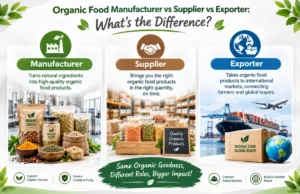
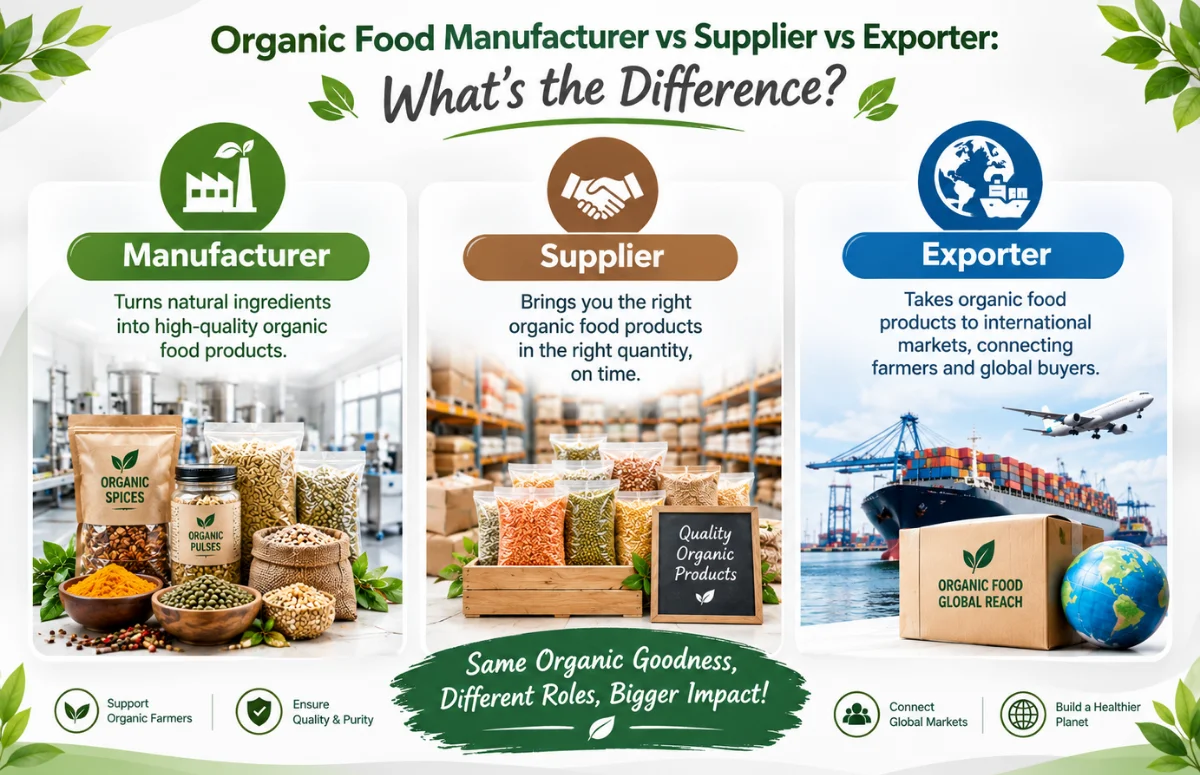
The Manufacturer the one who actually makes the thing
A manufacturer is the party that transforms raw organic produce into a finished product. Think of someone taking organic wheat and turning it into flour or organic milk into ghee or raw turmeric roots into that fine yellow powder sitting in your kitchen jar. They own or lease processing units, they handle grinding packaging sometimes blending and critically they are the ones who need to hold the organic certification for processing not just cultivation.
Here’s the thing people miss: a manufacturer does not necessarily grow the crop themselves. Plenty of manufacturers buy organic raw material in bulk from farmer collectives and then process it under their own brand. So when you are dealing with a manufacturer you are really talking to someone about production capacity, batch consistency and processing standards not farming practices, though those obviously feed into it.
The Supplier the connector in the middle
Now this is where it gets a little murky because supplier is honestly a catch all term. A supplier could be someone who aggregates produce from multiple farms and sells it forward to manufacturers or retailers. Or they could be a distributor who buys finished organic goods and moves them into retail shelves hotels, export houses whatever. In India specifically a lot of suppliers sit right at that farmer-to-market junction they are the ones with the FPO Farmer Producer Organization relationships the cold storage tie-ups the logistics network to actually get organic rice or pulses from a village in Madhya Pradesh to a warehouse in Mumbai without half of it spoiling on the way.
An organic food supplier in India typically wears a few hats at once sourcing, quality checking sometimes light processing like cleaning and grading, and then distribution. What they are NOT usually doing is heavy manufacturing. If you ask a supplier for a customized product formulation you will probably get redirected to whichever manufacturer they work with.
I’ll be honest this is the segment where quality control matters most and varies the most. A good supplier tests batches keeps documentation tight maintains traceability back to the farm. A lazy one just reships whatever arrives and hopes for the best. You learn to tell the difference fast once you have been burned once.
The Exporter playing an entirely different game
Exporters deal with a whole separate rulebook. Beyond organic certification NPOP in India, which usually needs to align with NOP for the US or EU regulations depending on destination they are juggling phytosanitary certificates container logistics customs documentation currency fluctuations and buyer specific compliance requirements that change country to country. A shipment headed to Germany has different residue tolerance thresholds than one going to Japan. It’s a whole different beast.
What trips people up is assuming an exporter is just a supplier who happens to ship internationally. Not quite. Exporters usually need export licenses IEC codes, APEDA registration for agricultural exports specifically and a much deeper understanding of international trade compliance. Some large manufacturers also function as exporters directly cutting out a middleman while smaller manufacturers often rely on dedicated export houses to handle that whole process because frankly. It’s a lot of paperwork most farm level businesses do not have bandwidth for.
So which one do you actually need?
Depends entirely on what you are doing. If you are opening a retail store or a restaurant sourcing domestically you probably want a reliable supplier someone local ish with consistent stock decent lead times. If you are building a private label organic snack brand and need someone to actually process and pack your product that’s manufacturer territory. And if you are trying to sell Indian organic spices to a buyer in the UAE or the US you need either an exporter or a manufacturer with export capability already baked in.
There’s also overlap, which honestly makes this messier than it needs to be. Some businesses function as all three grow or source raw material process it in house and export finished goods themselves. Indian Farm Organics is one example that operates somewhat across this spectrum connecting farm level sourcing with supply to buyers. Who need volume and consistency rather than sitting purely in one lane. Not every company structures itself that cleanly though so it pays to just ask directly what they actually do before assuming.
Picking the right one a few things worth thinking about
Okay so now the practical bit. When you are vetting any of these manufacturer supplier or exporter do not just ask for their certificate and call it done. Certificates get renewed annually and honestly a photocopy of a cert tells you almost nothing about day-to-day practices. Ask for their certification body’s name and actually verify it against the APEDA or NPOP database. Takes five minutes saves you a headache later.
Ask about batch traceability too. Can they tell you which farm or cluster a specific lot came from? If they hesitate or get vague that’s a small red flag worth noting. Pricing matters obviously but if someone’s quoting way below market rate for genuinely organic produce, be skeptical organic farming costs more full stop and if the math does not add up somewhere. It usually means the organic claim is stretched.
Also and this one’s underrated ask about their minimum order quantities and lead times upfront. Nothing worse than negotiating for two weeks only to find out their MOQ is triple what you need. Communication responsiveness matters more than people give it credit for too. If a company takes five days to reply to a basic pricing question before you have even placed an order imagine what happens once there’s an actual problem with a shipment.
Relationships in this industry more than most run on trust built over repeat transactions. The first order is always a bit of a leap of faith. Start small if you can verify quality independently lab testing is not that expensive relative to what a bad batch costs you and build from there.
FAQ
Can one company be a manufacturer, supplier and exporter all at once?
Yes, and it’s fairly common actually especially among larger organic businesses in India that have scaled up over the years. Smaller or newer businesses tend to specialize in just one function though at least initially.
Do I need different certifications depending on which one I’m working with?
Sort of Manufacturers need processing certification specifically exporters need additional trade-related documentation like APEDA registration and suppliers generally need to maintain traceable sourcing documentation even if they are not processing anything themselves.
Is it cheaper to buy directly from a manufacturer instead of a supplier?
Sometimes, but not always manufacturers often have higher MOQs that do not make sense for smaller buyers so the savings evaporate once you factor in what you’d do with excess stock.
How do I know if an organic exporter’s certification is legitimate?
Cross-check their certificate number against the certifying body’s public database NPOP has one and most accredited certifiers list active clients too. If a company’s reluctant to share this info that itself tells you something.