I remember standing in a farmer’s market in Pune. A few years back watching a vendor pull carrots out of a crate. That still had clumps of soil on them. No shine no wax nothing that made them look like they belonged on a supermarket shelf. And honestly that’s when it hit me organic food does not look perfect. because it is not trying to. It’s grown the way food used to be grown before we got obsessed with uniform. Shapes and year round availability of everything.
Here’s the thing though most people think organic just means no pesticides. That’s part of it sure but the actual journey from farm to table involves a lot. More moving pieces than people realize. Let’s walk through it properly.
It Starts With the Soil Not the Seed
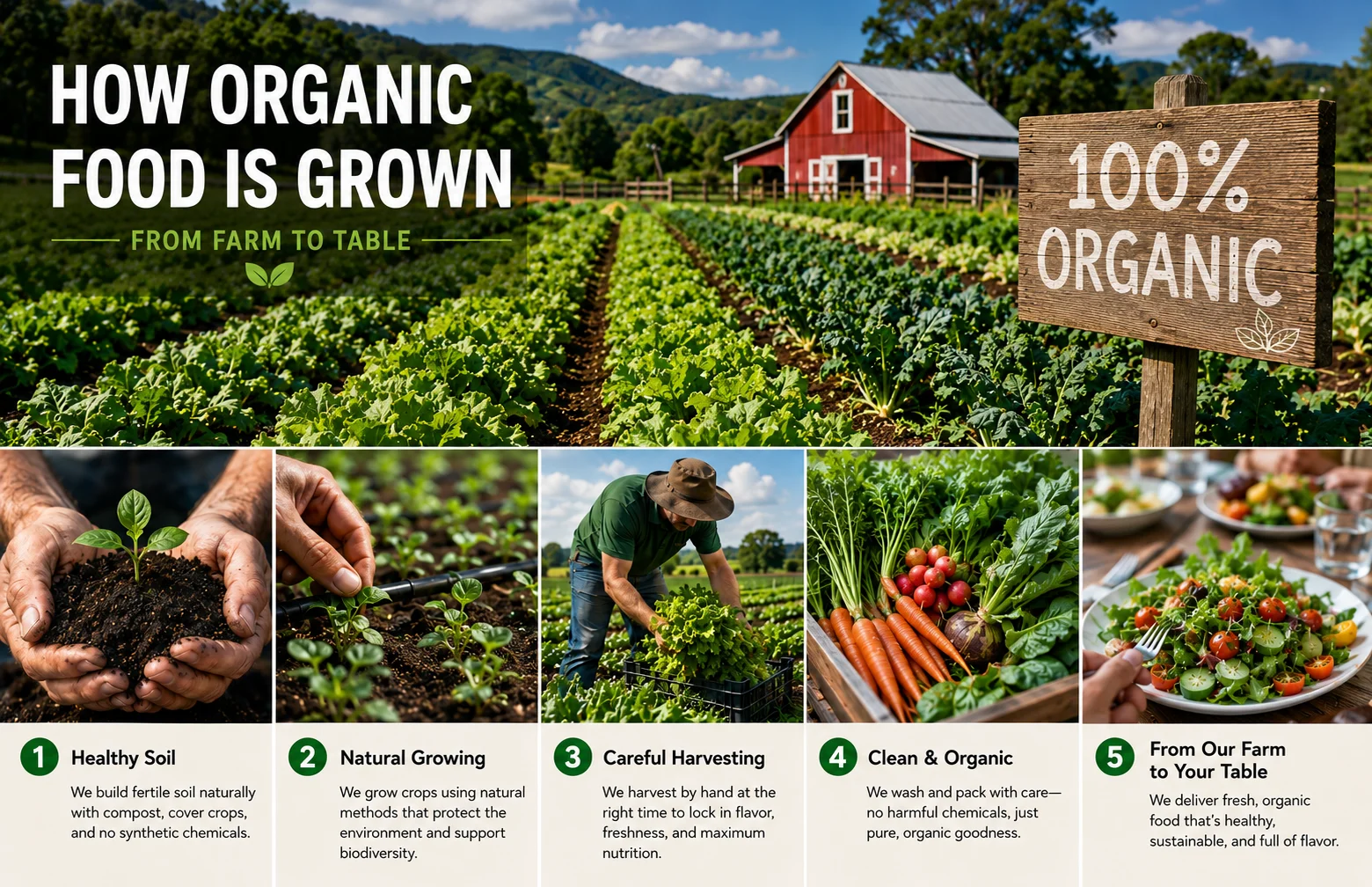
Every organic farmer will tell you the same thing. If you ask them what they actually spend most of their time doing it’s soil management. Before a single seed goes into the ground the land has to go through a transition. Period (usually two to three years in India depending on certification body). Where no synthetic fertilizers or pesticides are used. During this window farmers build up soil health using compost green manure crop rotation. And sometimes vermicomposting with earthworms doing the heavy lifting.
Now, this is important a lot of people assume organic farming is just regular farming minus chemicals. It’s not that simple. You are actively working to rebuild an ecosystem in the soil. Microbial life nitrogen fixation natural pest predators all of it has to come back before the land. Can reliably produce healthy crops without synthetic help. Farmers who skip this step or rush it usually end up with poor yields. And blame organic farming for not working when really the groundwork was not done properly.
Pest and Weed Control Gets Creative
Since synthetic pesticides are off the table, organic farmers lean on a mix of old-school and clever techniques. Neem-based sprays, companion planting (marigolds next to vegetable rows to repel certain insects, for instance). Crop rotation to break pest cycles, and encouraging natural predators like ladybugs. Weeding is often done manually or with mulching rather than herbicides. Which I will be honest is backbreaking work and one of the reasons organic produce costs more. Labor is not cheap and organic farms need a lot more of it.
Harvesting and the Certification Maze
Once crops are ready harvesting is typically done by hand or with minimal mechanical intervention to avoid damage and contamination. But here’s where things get bureaucratic for a product to legally carry the organic label in India. It needs certification under NPOP (National Programme for Organic Production) or PGS-India (Participatory Guarantee System). Which is a bit more community based and suited to smaller farmers. Who can not afford the expensive third party audits.
I have talked to a few small farmers. Who genuinely grow everything organically but do not bother with certification. Because the paperwork and cost just are not worth it for their scale. Which raises an uncomfortable point not everything organic on sale is certified and not everything. Certified is necessarily grown with the same care a small dedicated farmer puts in. It’s a mixed bag and consumers need to do a bit of homework.
From Farm to the Middleman (or the Lack of One)
This is where the supply chain either makes or breaks the whole organic promise. Traditional food supply chains have layers aggregators, wholesalers, distributors and each layer adds cost and time. Which is not great for perishables. Organic supply chains have been trying to shorten this with many suppliers building direct farm-to-consumer models.
Take Organic India for example they have built a reputation mostly around herbal teas and wellness products. Working closely with contracted farmer networks rather than open-market procurement. Then there’s 24 Mantra Organic which has pushed hard into affordability and mass retail presence. Trying to make organic staples less of a niche premium-only category. Sresta Natural Bioproducts (the folks behind 24 Mantra) actually run one of the more vertically integrated models in the country. Controlling things from farmer training right up to packaging.
Suminter India Organics is another name worth knowing if you are digging into this space. They work extensively with export markets and have built decent traceability systems. Which matters a lot when you are shipping produce internationally and buyers demand proof of origin. Conscious Food based out of Mumbai takes a slightly different approach smaller scale more focused on sourcing from small farmers. Directly and honestly their model feels closer to what people imagine when they hear organic in the first place.
Nourish Organics carved a niche in the packaged snacks and superfoods space rather than raw produce. Which shows how the organic label has expanded beyond just vegetables and grains into everyday pantry items. And Organic Tattva works with a farmer network running into the thousands focusing on staples like pulses, flours. And spices with an emphasis on testing every batch for purity. Which given how much fake organic labeling exists in the market, is not a bad thing to prioritize.
Somewhere in this mix you will also find newer smaller players trying to build trust the old-fashioned way. Through transparency about where the produce comes from rather than just slapping a green leaf logo on the packet. I came across indianfarmorganics.com a while back while researching regional suppliers. And what stood out was how much emphasis they put on farmer partnerships rather than just being a retail storefront. Which, honestly, is the direction more organic food supplier in India businesses. Should be heading if the whole point is supporting sustainable agriculture rather than just cashing in on a trend.
Choosing a Supplier What Actually Matters
Okay, so how do you actually pick one of these suppliers without getting lost in marketing language? Honestly, start with certification check if they display NPOP or PGS-India marks clearly, not buried in fine print. Then look at how transparent they are about sourcing. Do they mention specific farms or regions or is it vague sourced from nature” type language? That vagueness is usually a red flag.
Price is tricky too organic food should cost more than conventional, given the labor and lower yields involved. If something’s suspiciously cheap and labeled organic, be a little skeptical. Also, pay attention to how they handle storage and delivery especially for perishables. A supplier that ships vegetables in unrefrigerated trucks for two days. Is not really preserving the value of organic no matter how clean the farming was.
And honestly, talk to people who’ve actually ordered from them if you can. Reviews online are helpful but word of mouth in local communities (WhatsApp groups local Facebook pages) tends. To be more honest than curated testimonials on a website.
FAQ
Is organic food actually pesticide-free or just less pesticide?
Certified organic farming prohibits synthetic pesticides entirely but natural pesticides like neem extracts are allowed. So it’s not zero intervention just a different category of intervention.
Why is organic produce more expensive?
Mostly labor and yield. Manual weeding crop rotation reducing output per season and certification costs all add up. There’s no way around it currently.
Can I trust organic labels at local markets that aren’t certified?
Not automatically. Some small farmers genuinely farm organically without certification because it’s expensive, but others just use the word loosely. Ask questions and if possible visit the farm or check PGS India group listings for your area.
Does organic food actually taste different?
Subjectively yes many people say so especially with tomatoes and leafy greens. Scientifically it’s less clear cut and depends heavily on soil quality freshness and variety rather than just farming method alone.