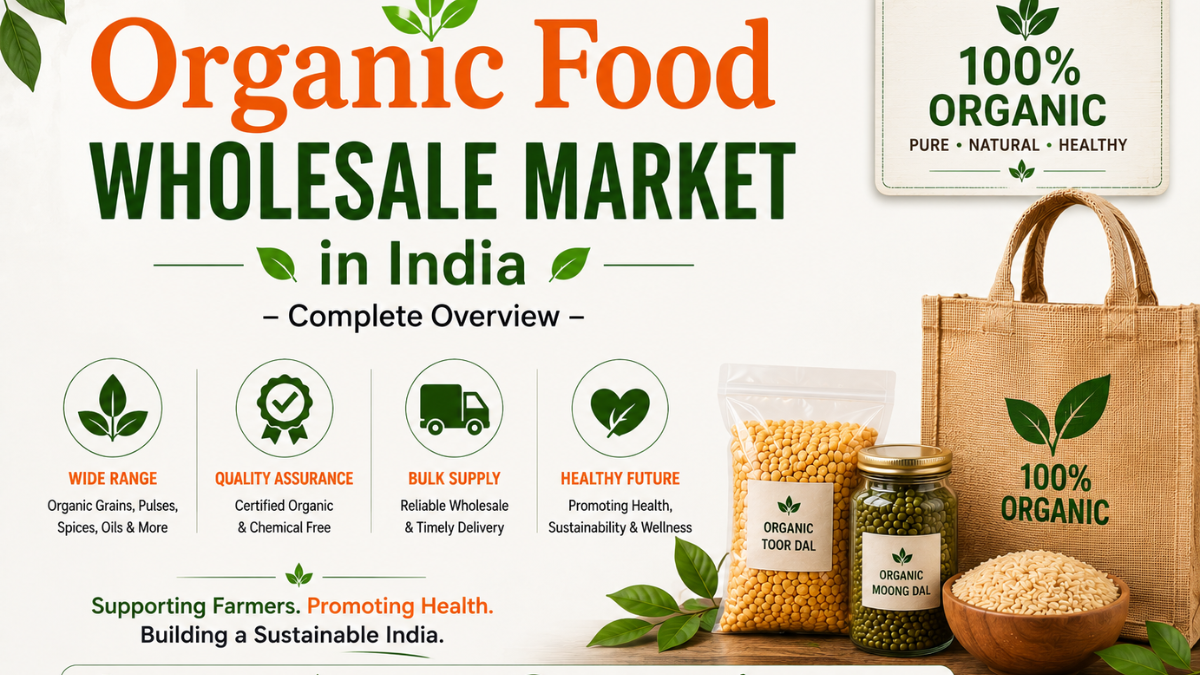
Walk into any mid-sized grocery store in Bengaluru or Pune today and you will notice something that wasn’t really there five years ago a proper organic section. Not just a shelf with two token products. But an actual dedicated corner with a range of items. Pulses, spices, cold-pressed oils rice varieties. That shift didn’t happen by accident. It happened because the wholesale supply chain behind organic food in India quietly grew up.
And yet most of the conversation around organic food in India stays at the consumer end. Which brands are good, which ones are overpriced, which ones are actually certified. Very little gets said about the wholesale side the B2B ecosystem that makes any of this possible. That’s what this piece is actually about.
The Wholesale Market Bigger Than You Think
India is now one of the largest producers of certified organic products in the world. As of recent years, the country had over 44 lakh hectares under organic certification with Madhya Pradesh Rajasthan and Maharashtra leading in acreage. But here’s the thing production being high doesn’t automatically mean the wholesale infrastructure is equally strong. For years that was actually the weak link.
The good news is that’s changing. A combination of government push (Paramparagat Krishi Vikas Yojana and similar schemes) growing export demand and a domestic middle class that’s increasingly reading ingredient labels all of this together has pushed the wholesale organic market to a point where it’s becoming genuinely structured. There are proper cold chains, certifying bodies, and increasingly suppliers who are serious businesses not just farms with a Facebook page.
If you are a retailer a D2C brand a restaurant chain, or someone setting up a health food business navigating this space takes some work. But it’s navigable.
Some Suppliers Worth Knowing About
Let me be upfront I am not going to pretend this is an exhaustive list. There are hundreds of regional players across India. What I am doing here is highlighting some of the better known or interesting ones along with what makes them notable.
Indian Farm Organics is one of those names that keeps coming up when you talk to people sourcing organic products at scale. They work across a fairly wide product range grains, spices dry fruits and processed organic goods and have certifications in place. Their website, indianfarmorganics.com, gives a reasonable picture of what they do. What I find notable about operations like theirs is the focus on farmer linkages not just aggregating and reselling. But working with the production side too. That matters for consistency.
Sresta Natural Bioproducts, the company behind the 24 Mantra Organic brand, has been in this space long enough to have gone through multiple cycles of the market. They source from thousands of farmers across Andhra Pradesh, Telangana and a few other states, and operate at a scale that most other organic players in India don’t. For wholesale buyers they are a significant option especially for staples like rice, dal and spices.
Morarka Organic Foods, based out of Rajasthan, has an interesting origin story rooted in farmer development work before organic became commercially interesting. They do exports but also supply domestically and they tend to be strong on the certification front. If you are buying for a market that asks a lot of questions about traceability they are worth talking to.
Then there’s Organic India which most people know for their tulsi teas and herbal products. But on the wholesale side, they are a meaningful supplier for herbal ingredients and certain processed organic products. They work with a large network of small farmers, primarily in Madhya Pradesh and Uttarakhand. The Himalayan sourcing angle isn’t just marketing it actually reflects their supply geography.
Naturally Yours is a bit of a different beast. They started as a kind of curated online organic marketplace but have built out relationships with suppliers across product categories. For smaller retail buyers or startups that don’t have the volume to go direct to large farms, platforms like these are actually quite useful intermediaries.
Conscious Food out of Mumbai has been quiet but consistent they have been around since the 1990s which in the Indian organic sector is practically ancient. Their product range skews toward everyday staples and they have a reputation for being genuinely careful about sourcing standards.
Down to Earth Organics (not to be confused with the magazine of the same name) is another regional player worth knowing, particularly for buyers sourcing from the northeastern states or looking for specialty products like exotic rice varieties and forest-sourced items.
And honestly, if your sourcing needs are highly specific say, a particular variety of black rice, or millets from a specific agro-climatic zone sometimes the best option is to go directly to a state level farmers producer organization (FPO). Sikkim Organic, for instance operates out of India’s first fully organic state and has supply connections that large distributors often don’t match in terms of niche product availability.
How Do You Actually Choose a Supplier?
This is where a lot of buyers get tripped up. They focus entirely on price, which while obviously important is maybe the third or fourth thing that should matter when you’re buying organic wholesale.
The first thing, honestly, is certification. Not all certification bodies operating in India are equal. APEDA recognized certifiers, Ecocert, LACON and a few others carry genuine weight. If a supplier shows you a certificate from a body you have never heard of that’s worth probing. Ask for the certificate number and verify it directly on the NPOP (National Programme for Organic Production) database. This sounds tedious but it’s a ten-minute exercise that can save you from a bad situation later.
Second and this matters more than people admit is the supplier’s understanding of what you actually need. A good organic food supplier in India should be asking you questions: what certifications your downstream buyers require, whether you need farm level traceability what your packaging requirements are, minimum order quantities. If they are just quoting you a price list without any back-and-forth that’s a signal.
Third is product consistency. Organic products, by nature, have more natural variation than conventionally produced goods. But within that, there’s still a range. Ask for samples across at least two different batches. Check moisture levels color and for grains and pulses impurity levels. A supplier who’s confident in their product will happily send samples.
Pricing comes after all of this. Obviously you need it to work commercially, but organic wholesale pricing in India has a fairly established range for most product categories. If someone is quoting you significantly below market, that’s more likely a sourcing or certification problem than a lucky deal.
One more thing relationships with the supplier’s procurement team, not just the sales team are valuable. Knowing who is buying from farmers on the other end of your supply chain is the kind of ground-level awareness that helps when there’s a crop failure or quality issue. This is India; relationships matter.
A Few Questions People Ask
Is organic produce in India actually certified, or is it mostly marketing? It varies enormously. There are rigorous certification systems operating here NPOP for domestic and exports to certain markets PGS-India for local markets, and equivalency arrangements with EU and US certification systems. The problem is that organic claims without any certification are also fairly common, especially in smaller markets. So the answer is: yes genuine certification exists and is meaningful, but you have to look for it specifically.
What’s the minimum order quantity for most organic wholesalers? This depends heavily on the supplier and product category. For large commodity suppliers, MOQs can be in the range of a few hundred kilograms to a metric ton. Specialty or smaller suppliers might work with MOQs of 25–50 kg. If your volumes are genuinely small, aggregator platforms or co-ops might be more practical than going direct to a farm-level supplier.
Can I export if I source organically from India? Yes, and India is actually a significant organic exporter spices oilseeds, pulses, processed products. But export certification requirements differ from domestic ones. If you are sourcing with export intent, you specifically need NPOP-certified product and potentially additional certification depending on the destination market (NOP for the US, for instance). Worth discussing with your supplier upfront.
Are prices for organic wholesale stable, or do they fluctuate a lot? More volatile than conventional generally. Organic farming has lower yields and weather related losses can be sharper. For staple commodities like rice and wheat prices tend to be roughly 30–50% above conventional market rates but can spike with bad monsoons. For specialty products, the variability can be wider. Locking in contracts with trusted suppliers rather than buying spot is how most serious buyers manage this.
The organic wholesale market in India is maturing slowly, but genuinely. It’s not perfect it’s still fragmented in places. And finding the right organic food supplier in India for your specific needs still requires some legwork. But the infrastructure is there if you know where to look and what questions to ask.