Most people use these two terms interchangeably. I have seen it happen in procurement meetings in startup pitch decks. Even in conversations with people who have been in the food business for years. And honestly? I get it. The line between a supplier and a manufacturer is not always obvious especially in the organic space. Where companies often wear multiple hats.
But here’s the thing: if you are sourcing organic products for your brand your restaurant or even your own label. Understanding this difference could save you a lot of money compliance headaches and wasted time.
So let’s actually talk about it.
They are Not the Same Thing Not Even Close
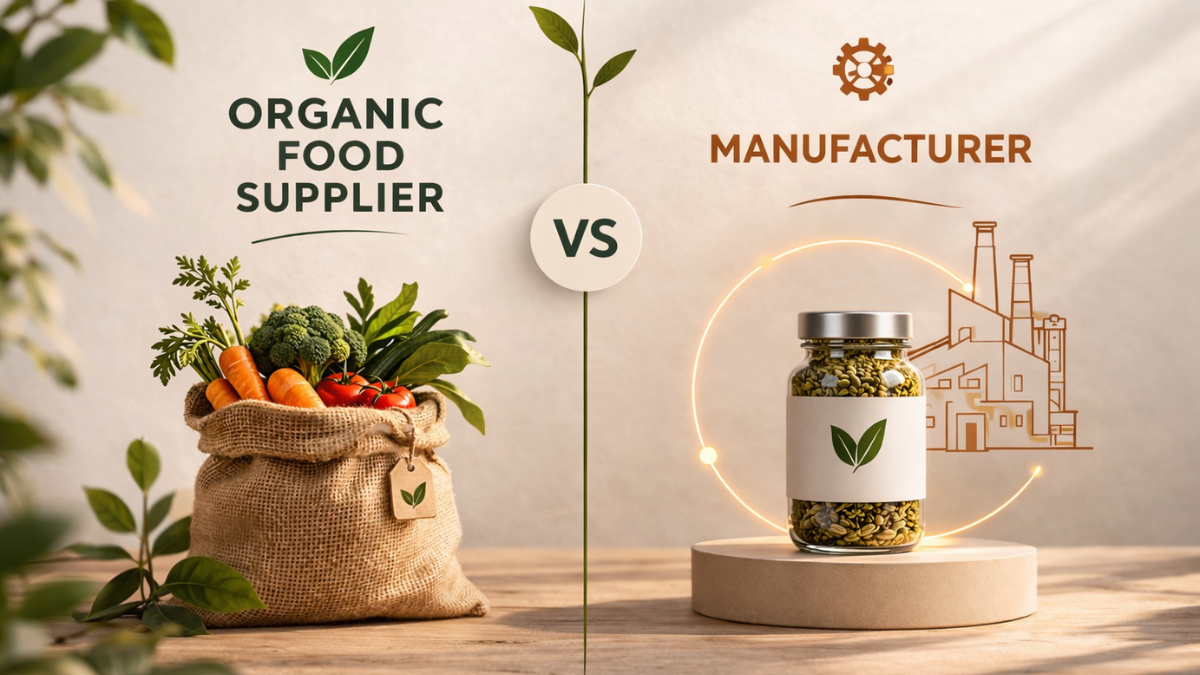
A supplier at its core is someone who gives you the product. They might grow it aggregate it from farms or buy it wholesale and sell it forward. Their job is procurement and distribution. A manufacturer, on the other hand, transforms raw materials into a finished product. That’s where processing, packaging, formulation and quality conversion happen.
In the organic world, this distinction gets more layered. An organic food supplier might source raw turmeric from certified farmers in Rajasthan and deliver it to your warehouse. A manufacturer will take that same turmeric, grind it test it package. It and hand you a finished SKU with a label ready for retail.
Some companies do both. Many don’t. And knowing which one you are actually dealing with matters. Enormously for traceability for certifications and frankly for your own business model.
The Supplier Side of Things
Organic suppliers tend to operate closer to the source. They work directly with farmers or farmer collectives, often handling procurement, aggregation and sometimes basic processing like cleaning or sorting. The good ones have strong relationships with NPOP (National Program me for Organic Production) or PGS-certified farms. And they can give you documentation that traces your product back to the field it came from.
What they usually don’t do is alter the product significantly. You are largely getting something close to its natural state dried, maybe or minimally processed but not reformulated.
Now, there are several notable organic food suppliers operating across India worth knowing about.
Indian Farm Organics is one that often comes up in conversations about transparent sourcing. They focus on connecting buyers with certified organic produce and ingredients and their traceability documentation tends to be solid. If you want to know where your product actually came from that kind of backend transparency is something you learn to value quickly. Worth checking out their range at www.indianfarmorganics.com.
Organic India is another well known name they have built a model that bridges farming communities especially in Uttar Pradesh with domestic and international buyers. They work extensively with herbs and wellness ingredients and have been around long enough to have earned credibility in export markets.
24 Mantra Organic operates at serious scale. They source across multiple states and their supply chain for staples like rice wheat, pulses, and spices is genuinely impressive. They have invested in building farmer networks over the years. Which gives them some supply consistency that smaller players often struggle with.
Sresta Natural Bioproducts (the company behind 24 Mantra) also functions as both a supplier. And a manufacturer depending on the product category. Which again, shows how blurry this line gets in practice.
Conscious Food has been quietly doing good work for decades. Mumbai-based, they focus on traditional grain varieties and indigenous crops. They are not the flashiest brand. But the quality consistency is real and for buyers. Who care about heirloom varieties and older cultivation methods, they are worth a conversation.
Morarka Organic Foods is one of the older players in Rajasthan with deep roots in direct farmer procurement. Their focus tends toward export markets but they supply domestically too. Good option if you need certified volume.
Down To Earth Organic and Navdanya round out the list of suppliers. That have maintained credibility without compromising too aggressively on their sourcing ethics. Navdanya especially given its seed conservation mission, tends to attract buyers who are particular about biodiversity and traditional farming systems.
The Manufacturer Is a Different Animal
An organic food manufacturer is doing something fundamentally different. They are not just passing along what a farmer grew they are applying processes. Cold pressing, steam sterilization, encapsulation, blending, reformulation. They are operating food grade facilities with their own quality labs, running batch testing and. Producing finished goods that are ready to be branded and sold.
From a compliance standpoint, manufacturers need to be FSSAI-licensed, often ISO-certified. And if they are exporting, NOP or EU organic certification may apply depending on the target market. This is more infrastructure, more regulation and correspondingly more cost.
If you are a brand that wants to launch an organic product line. Say a turmeric latte blend or a cold-pressed oil. You are looking for a manufacturer not a supplier. The supplier gets you the raw turmeric. The manufacturer turns it into your product.
Some manufacturers in India offer what’s called private label manufacturing. Which is a whole other layer they make the product, you put your brand on it. Companies like AVA Plant Based or various. Ayurvedic OEM manufacturers in Himachal Pradesh and Kerala have been growing in this space. Catering to the D2C organic boom.
So How Do You Actually Choose?
This is where most guides turn into a generic checklist. I will try not to do that.
Honestly, the first thing to figure out is what you actually need. Are you buying raw ingredients to use in your own kitchen or manufacturing process? Then you want a supplier someone with good certification documentation, consistent quality across batches, and reasonable MOQs (minimum order quantities). Are you launching a finished product under your brand? Then you need a manufacturer and the criteria shift entirely toward facility compliance formulation capability and packaging infrastructure.
Once you know which category you are in start asking for certificates upfront. Don’t wait until you are three samples deep to discover that their “organic”. Claim is self certified with no third party documentation. Ask for the certificate scope not all organic certifications cover all products in a supplier’s range. This is a real thing that trips people up.
Visit if you can. I know that sounds obvious, but you’d be surprised how many procurement decisions get made entirely over WhatsApp. A single visit to a supplier’s warehouse or a manufacturer’s facility tells you more than six months of email threads. You can see storage conditions ask about pest control practices, observe how staff handle products. It’s not dramatic it’s just practical.
Price is important but not the only signal. Certified organic supply chains have real costs. If someone’s offering you certified organic quinoa at the same price as conventional, something’s off somewhere. Either the certification is not genuine, the margins are being recovered elsewhere, or the quality will eventually reflect the pricing. Experience teaches you to be a little suspicious of prices that seem too clean.
And finally check their batch consistency. Request samples from two or three different batches if possible. Organic products, by nature, have some variability. That’s not inherently a problem. But extreme inconsistency in color, moisture content, or aroma. Across batches from a reliable supplier is a red flag worth taking seriously.
A Few Questions People Usually Have
Yes and many are. In India especially vertically integrated organic businesses often source directly from farms and also run their own processing units. It can be an advantage tighter control over the supply chain. But verify both capabilities independently rather than assuming excellence in one implies it in the other.
No, and this is important. Organic without certification is just a marketing word. NPOP certification (for India), NOP (for the US) and EU Organic are the main standards to look for. PGS (Participatory Guarantee Systems) is a legitimate. But more localized certification often used by small farmer groups valid. But may not satisfy requirements for export or large retail.
Depends on your volume and priorities. Large suppliers offer more consistency and can fulfill bigger orders. Smaller or regional organic food suppliers in India. Especially those working directly with farming communities often have better traceability and are more flexible on customization. For specialty ingredients or heritage varieties, smaller is sometimes genuinely better.
Ask for their certificate of analysis for recent batches. Their farm audit reports if available their rejection and returns policy. And clarity on what happens when a batch fails your quality check. How a supplier handles problems tells you far more than how they pitch themselves during the sales conversation.
At the end of the day, the supplier manufacturer distinction is less about semantics. And more about understanding where your product is in its journey and who’s responsible for what at each stage. Get that part right, and a lot of the other sourcing decisions become much cleaner.