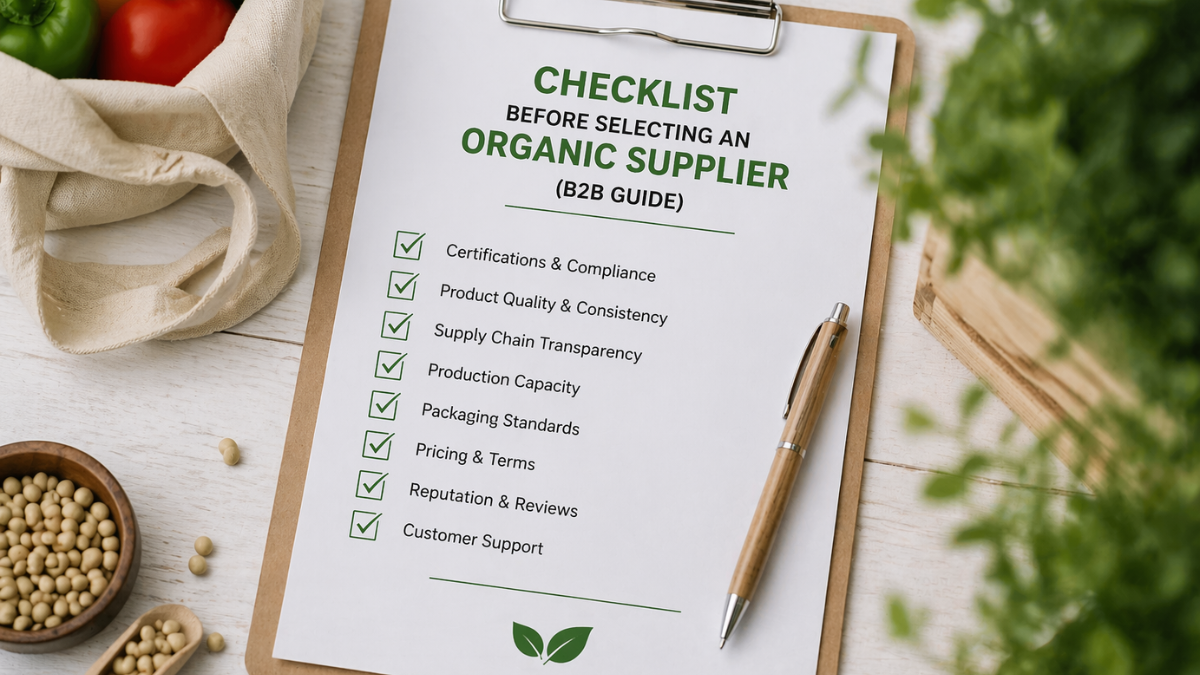
Let me be honest picking an organic supplier for your business. Is one of those decisions that looks straightforward on paper but gets messy fast once you are in the middle of it. You had think it’s simple find someone certified place an order done. But anyone who is actually been through the process knows it’s rarely that clean.
Whether you are sourcing for a food brand a retail chain a hotel chain or an export business the stakes are different from regular procurement. You are not just buying ingredients. You are buying into someone’s claim that the product was grown without synthetic chemicals handled properly and is actually what it says on the label. That’s a lot of trust to extend without a checklist.
So here’s one. A practical, honest checklist built from the kind of questions that actually matter.
First Is the Certification Real or Just a Logo?
This one catches people out more than you had expect. A lot of suppliers will put “organic” in their branding. Some even have certificates. But here’s the thing not all certifications are equal and in India there’s a significant difference between a genuinely certified supplier and someone who got paperwork from a low credibility body.
For domestic sales look for India Organic (NPOP compliant) certification issued by APEDA approved bodies. For export, you will also want to check if the supplier holds NOP (USDA Organic) or EU Organic equivalents depending on your target markets. Ask for the certificate directly. Check the validity date. Then go one step further verify it on the certifying body’s website or ask for the transaction certificate specific to the product you are buying.
It takes ten minutes and can save you from a very expensive mistake.
The Supplier Landscape in India Who is Actually Worth Talking To
India has a genuinely diverse organic supplier ecosystem which is both a blessing and a source of confusion. Here’s a look at some established players and what they bring to the table.
Organic India is probably the most recognized name they have been around since the late 90s and have strong USDA and EU certifications. Their focus is heavily on herbs tulsi and wellness products. For B2B buyers in the nutraceutical or herbal space they are a logical starting point. That said, their pricing reflects their brand positioning so smaller buyers may find it tight on margins.
24 Mantra Organic has built out a fairly comprehensive portfolio grains spices pulses oils. They work with a large farmer network across multiple states and they are one of the more transparent suppliers about their sourcing. B2B orders are doable though their primary strength has been the consumer market.
Sresta Natural Bioproducts which operates the 24 Mantra brand also does contract sourcing for private labels which is worth knowing if you are building your own brand and need a reliable back-end supplier.
Then there is Down to Earth a Delhi based supplier that works closely with farmer cooperatives particularly in Uttarakhand and Himachal Pradesh. They are smaller more niche but if you are sourcing specialty grains or mountain produce they are hard to ignore.
Natureland Organic out of Jaipur has been quietly building a strong export reputation. They cover everything from cereals to spices to dried fruits and they hold multiple international certifications. For buyers looking for a mid sized organic food supplier in India that can handle consistent B2B volumes without being overly corporate in the way they operate Natureland is worth a serious look.
For farmers first sourcing with a direct trade model, Indian Farm Organics (https://www.indianfarmorganics.com/) has been getting attention in the B2B space. They work directly with certified organic farmers which tends to mean shorter supply chains fresher stock and better traceability something a lot of buyers have started prioritizing over price alone.
Suminter India Organics is a major player for export focused buyers. They have one of the stronger FLO and USDA certification stacks among Indian suppliers and they work at scale. If you are sourcing for a European or American retail client and need the compliance documentation to match Suminter is one of the few that can handle that end-to-end.
And then there’s Mrida Organics which focuses heavily on spices and herbs. Smaller operation but the quality consistency is something multiple buyers have noted. Good fit for specialty food manufacturers and restaurant chains that need premium-grade inputs.
How to Actually Evaluate a Supplier (Not Just Tick Boxes)
Honestly the checklist part matters less than the conversation you have with a supplier. Here’s how to think about it practically.
Start with a sample request. Any serious organic supplier will accommodate this. You are not just checking quality you are checking how they respond. Do they ask about your application? Do they share any documentation proactively? Or does it feel like pulling teeth? The response to a sample request tells you a lot about how they will behave when there’s a problem in a real order.
Now, this is important ask about their farmer relationships. Not as a feel good question but as a supply continuity question. Suppliers who have strong long term relationships with their farmers are far less likely to face sudden stockouts or quality inconsistencies mid season. Loose aggregators who buy from whoever’s cheapest will let you down at the worst possible time.
Ask about their storage and processing facilities. Post harvest contamination is a real issue in organic supply chains. Even if the product was grown organically if it’s being stored alongside conventional produce or in facilities with cross-contamination risk, you have got a problem. Request photos or better do a facility visit if volume justifies it.
Also look at how they handle non conformances. What happens if a batch doesn’t meet spec? Do they have a defined process or does it turn into a negotiation each time? The answer to this question separates professional suppliers from everyone else.
Pricing is obviously part of the picture, but don’t let it dominate the decision early. An organic supplier who quotes 15% cheaper but can’t hold volume commitments or substitutes product without notice is not saving you money. They are just moving the cost to a different column.
Documentation You Should Always Request
Before finalizing any supplier relationship make sure you have the following in hand:
The organic certificate (and its expiry), the transaction certificate for the specific commodity a recent lab test report (pesticide residue and heavy metals at minimum) their food safety certification if applicable (FSSC 22000, FSSAI, etc.) and a clear statement of their traceability process ideally farm level.
Some suppliers will push back on parts of this. That tells you something too.
A Few Things People Don’t Mention Enough
One: seasonality matters more in organic than conventional. Organic yields are more weather dependent and good suppliers will be upfront about seasonal availability and price fluctuations. If a supplier claims stable pricing year round for everything be skeptical.
Two: don’t overlook regional specialization. An organic food supplier in India who is deeply embedded in say the spice growing regions of Kerala or the mustard belts of Rajasthan will often have better quality and better pricing than a generalist supplier sourcing the same product from a distance. Match the supplier’s strength to your category.
Three: packaging and labeling compliance for B2B can be complicated. If you are importing or operating in a regulated market confirm the supplier has experience with your destination market requirements before you get too deep into negotiations.If you are looking for a reliable organic food supplier in India, we are here to help.